
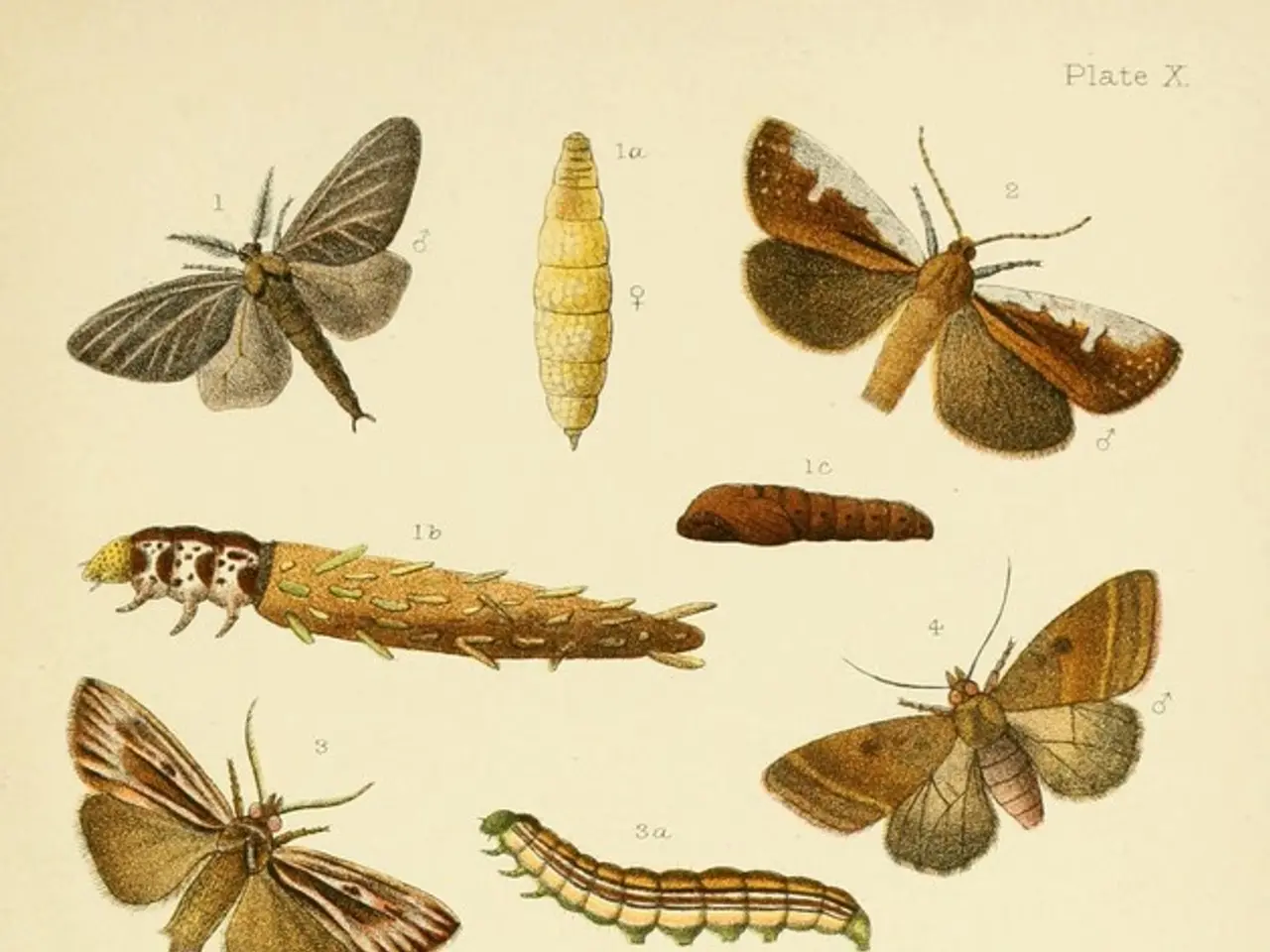
"Ohio Sees Unusual Sight: The Invasion of Sphinx Moths"
Sphinx moths, also known as hummingbird moths, are a fascinating group of insects known for their vibrant colours, long tongues, and unique preferences for certain types of flowers. These moths belong to the family Sphingidae, which contains over 1,400 species worldwide, including 115 in North America.
One of the most distinguishing features of sphinx moths is their physical appearance. They have stout abdomens, front wings much larger than the back wings, and extremely long tongues (proboscises). This long proboscis allows them to reach deep into tube- and horn-shaped blooms for feeding.
Sphinx moths vary widely in colour, markings, and wing shape. The white-lined sphinx moth is recognizable by the thick, pale, diagonal lines running across each of its front wings, the vertical white stripes on its thorax, and the pink bands on its back wings. On the other hand, the five-spotted hawk moth looks similar to the tobacco hawk moth but is distinguished by five pairs of orange spots along its abdomen, compared to six pairs on the tobacco hawk moth.
The tobacco hornworm and the tomato hornworm, the larval forms of the tobacco hawk moth and the five-spotted hawk moth respectively, feed on the same nightshade plants. However, the tomato hornworm's horns are black rather than red, and its stripes along each side are completely white and shaped like sideways Vs, differing from those of the tobacco hornworm.
The five-spotted hawk moth is nocturnal and feeds on night-blooming or crepuscular flowers, including some species of phlox, bouncing bet, and sundrops. The tobacco hawk moth follows a similar pattern, feeding from crepuscular and night-blooming flowers like wild tobacco, Japanese honeysuckle, moonflowers, and petunias.
Sphinx moths play a crucial role as pollinators for many wildflowers and garden plants. The Hummingbird clearwing moth and the Snowberry clearwing moth are two diurnal species that contribute to this pollination. The Hummingbird clearwing moth has rich reds and olive-greens that make it appear more hummingbird-like than other sphinx moths, while the Snowberry clearwing moth has yellow and black body patterns and clear wings.
The white-lined sphinx moth is common and widespread throughout North America, as well as parts of Central America. The five-spotted hawk moth is widespread throughout the United States, but is more abundant in the North than the South. The Snowberry Clearwing (Hemaris diffinis) is distributed across parts of North America, primarily in the United States and southern Canada.
Interestingly, the Snowberry clearwing caterpillar is light yellow-green with a green head, black horn, and black spots along their sides. The caterpillars of the white-lined sphinx moth have multiple color morphs, including light green with a horizontal yellow or yellow-and-black stripe across each side of their body and also have a series of orange or yellow spots parallel to the stripe. Some morphs are mostly black with a little green on the underside of their body.
In conclusion, sphinx moths are a diverse and visually striking group of insects that play a vital role in pollination. Their unique features, such as their long tongues and vibrant colours, make them a fascinating subject for study and observation.
Read also:
- Impact of Alcohol on the Human Body: Nine Aspects of Health Alteration Due to Alcohol Consumption
- Understanding the Concept of Obesity
- Tough choices on August 13, 2025 for those born under Aquarius? Consider the advantages and disadvantages to gain guidance
- Microbiome's Impact on Emotional States, Judgement, and Mental Health Conditions